
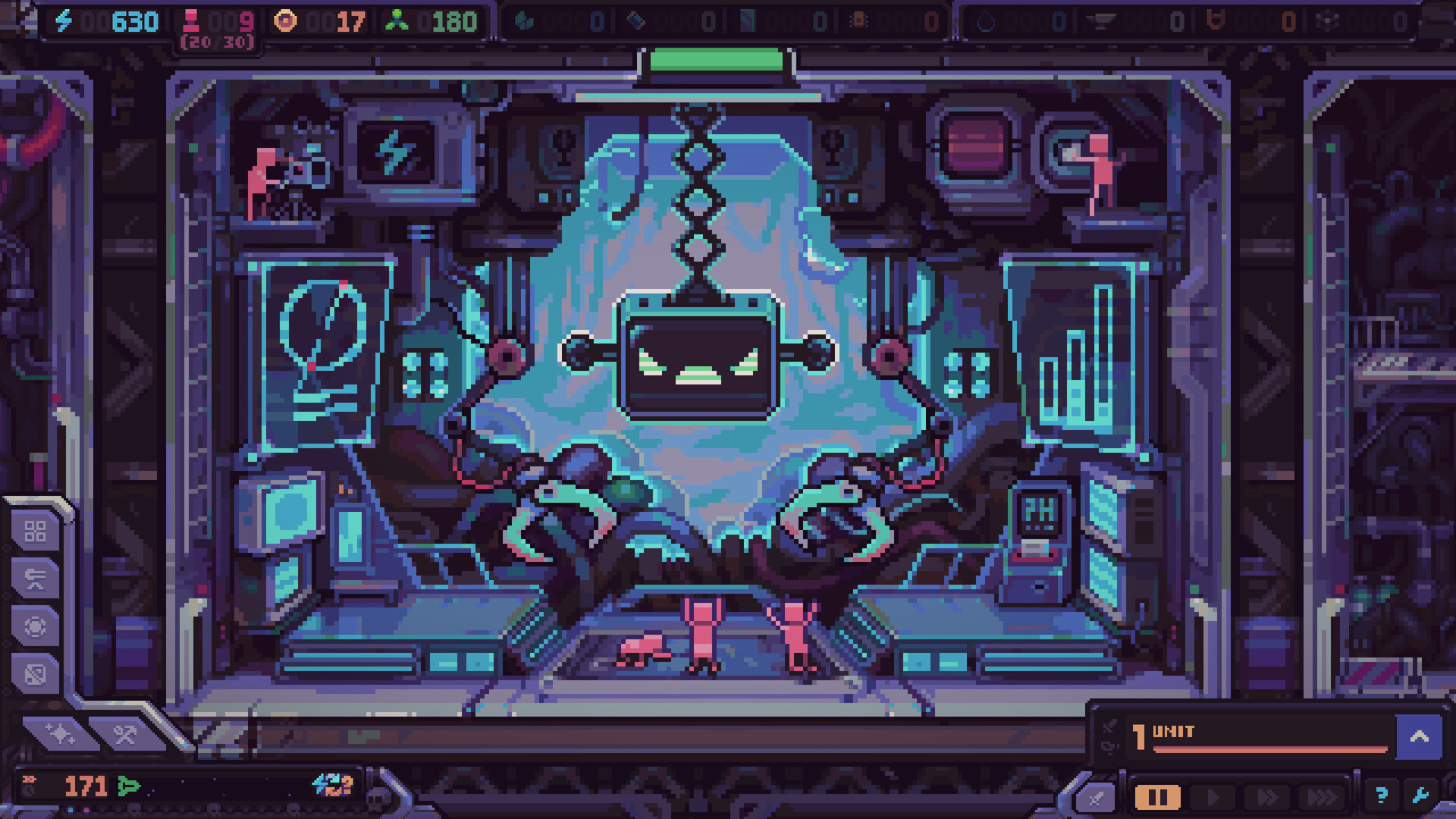
Official Steam screenshot · © 2026 Konfa Games / tinyBuild
Get useful work from the starting ship
Your first task is to understand the systems already available, rather than immediately maximize the ship's size. Production needs people doing the relevant jobs, so an unstaffed system is a practical issue to inspect before buying more equipment. The management devlog makes workforce and production interdependent, which is why the opening starts with useful assignments.
Look at what the ship currently needs and identify which existing jobs help provide it. If production is not keeping pace, adding more consumers can increase the same pressure instead of removing it. Make the next decision around a visible need, such as staffing a useful producer, rather than treating every empty position as an equally urgent assignment.
Keep humans and Energy in view together
Early growth depends on available humans as well as Energy. These are linked constraints, because a module does not become a functioning part of the economy simply by appearing inside the hull. Before committing to an addition, consider both the resource bill and the people needed to make the ship's existing and new systems useful.
This does not require a fixed worker ratio or a timed opening script. It requires checking whether the choice you are about to make can be supported by the ship as it exists now. If a useful system lacks workers, address that situation before assuming the next construction project will provide an immediate improvement to the whole run.
Read the kit before choosing to build
A kit represents equipment you can consider constructing, rather than a completed module with every cost already paid. The materials and labor associated with construction still matter after the kit becomes available. Read the requirements and decide what the equipment would solve before committing resources needed elsewhere aboard the ship.
If you can buy or obtain a kit but cannot build it, separate those two steps in your diagnosis. Check the kit, the construction requirements and the workforce available for the job. That is more useful than assuming a failed construction attempt always means the equipment is broken or that another random purchase will solve the underlying shortage.
Expand when the next room has a purpose
The developer warns against expanding faster than the supply of Energy and Fuel can support. A larger vessel can create additional operating and travel demands, so expansion is not automatically a net improvement. Identify the module space or defensive route you need before committing to more hull simply because construction is available.
Consider what the next addition will let you do that the current ship cannot do well. If it provides useful space but leaves an essential supply unsupported, it may be better to stabilize the existing arrangement first. The aim is not to avoid growth, but to make growth serve the economy and defense that will keep the run alive.
Prepare the approaches before the wave
Hull shape and turret placement should be considered together. An expansion influences where aliens travel, so it also influences which defensive positions are useful. Look at the route created by your current layout and prepare coverage where the available weapons can contribute, rather than building a large ship and treating protection as an afterthought.
Keep a reserve for the next immediate need instead of spending everything on an attractive future plan. That is an editorial planning principle, not a hidden in-game resource formula. It helps connect early construction decisions with the practical requirement to defend the ship while its production systems are still developing.
Use the release construction rule
In the full release, any empty module slot is available for building. The November FAQ explicitly removes the demo restriction that required a completed neighboring module before an empty slot could be used. A new player following older footage can therefore encounter advice that makes construction seem more restrictive than the release actually is.
Check the available slot and the real construction requirements before adding something only to create adjacency. The removed rule should not be confused with a useful bonus that happens to depend on positioning. Start from the full-release placement rule, then read any specific equipment or modifier description that adds its own separate consideration.
Diagnose a weak opening by its symptom
When production is insufficient, inspect the system doing the work and the resources it needs. When construction is unavailable, inspect the kit and its construction requirements separately. When attacks reach the final defense too easily, inspect the enemy approach and the coverage your existing hull actually allows before deciding that the only answer is another producer.
These questions help distinguish different reasons a run can feel stalled. A shortage in one part of the ship should not automatically lead to spending in another unrelated part. Change the system responsible for the problem, then reassess whether that change has restored enough stability to support the next planned expansion.
Build an adaptable first-run habit
Learn what each offered kit contributes before pursuing a rigid shopping list. The material supports staffing, resource checks and deliberate expansion as useful foundations, but it does not establish one guaranteed sequence of purchases. A first run becomes easier to understand when each new choice responds to the current ship instead of depending on equipment that may never appear.
Return to the same short set of questions as the vessel grows: are the useful jobs staffed, can the economy support the next addition and are the approaching routes covered? Use the power and production pages when those checks expose a shortage. Use the hull and defense pages when the economy is working but the battlefield is not.
Practice a useful opening review
Before the next construction decision, describe the job the new equipment is supposed to perform. If that description is only that the ship will look bigger or more developed, inspect the actual shortage or defensive gap again. Identify the useful producer, workforce or approach that needs attention and compare the proposed kit with that need. This exercise does not require an exact purchase sequence, because it begins with the equipment and resources already available to your run.
After choosing an improvement, review what it asks from the rest of the ship. A construction decision can involve resources, workers and space while also changing the priorities of the growing vessel. Keep those demands visible before committing to another project. Learning to explain why the next addition helps is a stronger first-run habit than memorizing a build whose important kit or resource support may not be present in the current attempt.
Sources and version notes
- Devlog #1 — Base Building and Ship Management · 2026-05-23
- Everything You Need to Know Before Hull Rupture Launches · 2026-11-02
- Devlog #2 — Not Your Typical Tower Defense · 2026-06-18
Source dates identify the announcement or discussion behind the information. Historical demo rules are distinguished from the full-release changes described in the article.
Send a correction →