
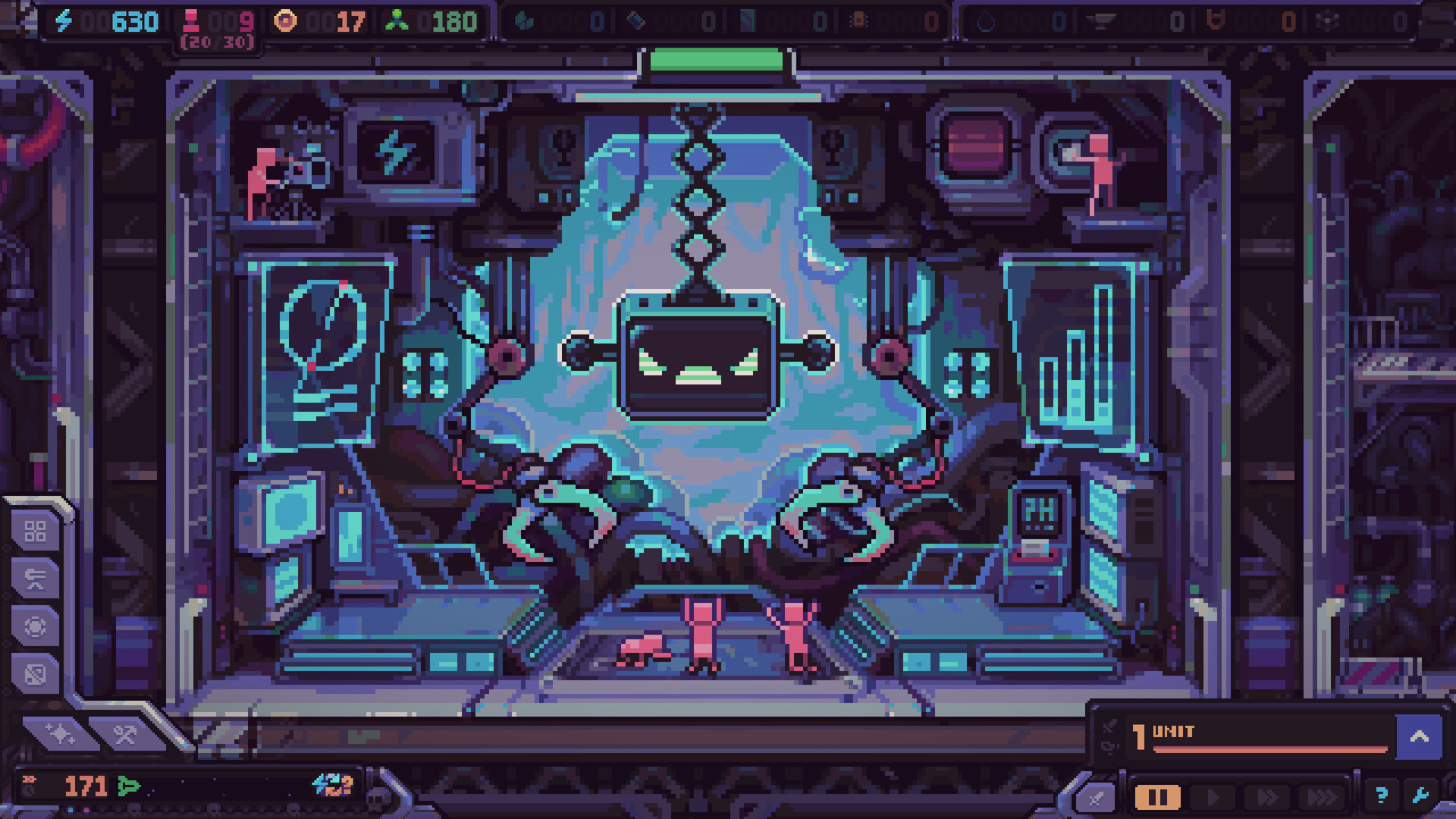
Official Steam screenshot · © 2026 Konfa Games / tinyBuild
Understand the real-time survival loop
Hull Rupture combines real-time ship management with automated tower defense. You construct and operate systems aboard a growing spaceship while alien attacks test the resulting layout. The important distinction is that running the economy and preparing the battlefield belong to the same run, rather than being separate game modes you alternate between freely.
Begin by understanding what the current ship can support, then decide which weakness the next investment should address. A production addition should help provide something the ship needs, while a defensive addition should improve protection along an actual enemy approach. Thinking in those terms makes it easier to evaluate an offered kit without needing a predetermined shopping list.
Know what wins and loses Classic
The developer's November release explanation establishes the Classic objective as surviving 20 waves. Despot must remain alive throughout that challenge, because losing all of his HP ends the run. The objective therefore gives your economic decisions a practical purpose: resources ultimately need to support a ship that can survive the remaining attacks.
Classic begins as the baseline experience, with one ship initially available. Additional ships and modes unlock through progression, so the full content total should not be confused with the choices on a fresh save. Learning the initial combination of management and defense is useful before planning around options you have not unlocked yet.
Make staffing an early priority
Production depends on more than owning a module. Available humans and the jobs they perform are part of the management problem, alongside Energy and the resources needed for construction. When an essential system is not contributing, inspect its staffing and requirements before assuming that a larger ship will automatically solve the shortage.
The management devlog warns that premature expansion can exceed the ship's Energy and Fuel supply. That makes useful staffing a better starting question than simply asking how many rooms you can add. Establish what your existing systems can do, then grow in a way that those systems can continue supporting without neglecting defense.
Separate kits from construction spending
Getting access to equipment is not the same decision as paying to build it. A kit gives you an option, while construction still competes with other demands on your resources and workforce. Evaluate both parts of the purchase before committing, especially when the next wave or the ship's operating needs already require attention.
This distinction helps explain why an appealing piece of equipment may not be the best immediate investment. Ask what it would contribute, whether you can construct it and what else would have to wait. An adaptable plan uses the options actually available during the run instead of assuming a particular sequence of future equipment will appear.
Use the hull as part of the defense
The shape of the ship affects more than its internal capacity. Hull construction changes the path aliens take, which means an expansion can create both module space and defensive opportunities. Consider where an enemy would travel after the change and whether the weapons you have can take advantage of that movement.
Keep the Airlock in mind as a final defensive point, rather than treating everything before it as irrelevant. Routes and turret coverage should work together to intercept enemies on their approach. For the detailed placement rules, use the dedicated hull-construction guide instead of applying assumptions from other base-building games to this ship.
Treat travel as an economic decision
The ship must keep moving, and exploration also depends on the resources committed to movement. Workforce, propulsion and the growing vessel's demands therefore belong in the same budget as production and defense. A plan that considers only the next room or weapon can miss the wider cost of maintaining the journey.
Use the current state of the ship to guide the next route decision. If your limiting problem concerns resources or an unsupported system, consider that need before chasing a more ambitious expansion. This is a planning approach derived from the connected mechanics, rather than a claim that every run has one correct route or economic sequence.
Apply full-release rules to current runs
The November FAQ changes an important construction rule from the demo. In the full release, a module can be built in any empty module slot; completing a neighboring module is no longer required to make that slot usable. If an older guide tells you to extend an occupied chain first, check its date before applying that advice.
The full release also separates Endless from Classic. Completing the Classic objective should not be interpreted as automatically entering the older demo's continuation behavior. Version context matters when comparing builds, because a strategy can rely on a rule or progression structure that no longer applies to the same activity.
Decide what to improve next
At each meaningful investment, identify whether the problem is useful production, staffing, movement, construction space or defensive coverage. Follow the resource or route relationship behind that problem, then choose an addition that addresses it. This keeps decisions tied to the ship in front of you instead of an imagined ideal vessel with different equipment.
Use the beginner guide for opening priorities, the resource guide for shortages and the defense guide for coverage. The boss and 20-wave pages address preparation toward Classic completion without promising a universal winning build. Together, these references let you move from the overall loop to the specific system that is currently preventing progress.
Work through one decision before starting another
For a practical review, imagine the ship has a useful kit available but an essential producer is already struggling. Treat those as two observations rather than assume the new kit solves the shortage. Inspect the producer first, identify the missing support and compare that correction with the construction you were about to fund. This makes the next investment an answer to the current constraint, rather than another project competing with it.
Then inspect the enemy approach before spending what remains. A correction to the economy does not automatically correct a route that the current weapons cover poorly. Consider the two relationships in order and choose what the present ship can support. This small decision cycle brings the guide's main systems together: useful labor enables production, production funds construction and defense, and the hull determines where that defense has an opportunity to contribute before Despot is threatened.
Sources and version notes
- Everything You Need to Know Before Hull Rupture Launches · 2026-11-02
- Announcing Hull Rupture · 2026-04-23
- Devlog #1 — Base Building and Ship Management · 2026-05-23
Source dates identify the announcement or discussion behind the information. Historical demo rules are distinguished from the full-release changes described in the article.
Send a correction →