
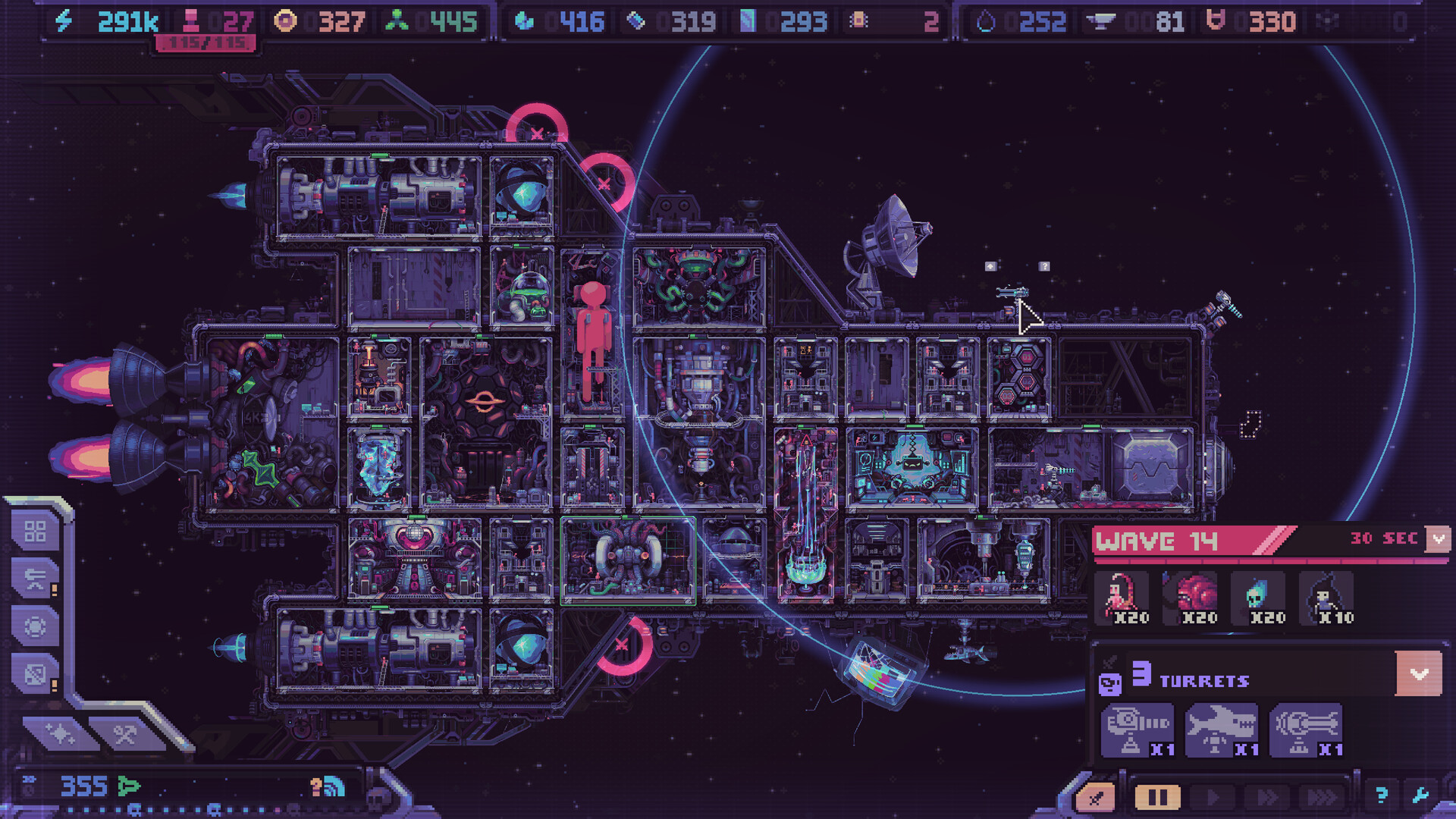
Official Steam screenshot · © 2026 Konfa Games / tinyBuild
Start from the equipment you can actually use
A build begins with the kits and support available during the run. An ideal list of equipment is not useful if the present ship cannot obtain, construct or support it. Look for a defensive direction that already has the ingredients to function, then compare the changes required to improve that direction with the cost of starting over.
This keeps the question concrete. Instead of asking which isolated weapon would be strongest on a different ship, ask which available combination improves the ship you have. The result is a selection framework grounded in the developer's described mechanics, not a claim of measured win rates or a tested ranking across every difficulty.
Match weapon behavior to hull geometry
The combat devlog treats weapon behavior and the route as connected choices. A straight lane can make sense for piercing fire, while a winding or enclosed space can support a different firing role. The same weapon can therefore have different practical value depending on the approach created by your current construction.
Inspect the route before committing to the equipment plan. If the intended weapon has no suitable place to contribute, the build requires a geometric solution as well as a purchase. Avoid counting a turret as an improvement merely because it is expensive or visually impressive when the route does not provide the opportunity its firing behavior needs.
Compare an expensive-turret economy with bonuses
The developer explicitly describes building an economy that can support expensive defensive equipment. That direction makes production part of the combat plan, because the weapon investment has to be funded by the rest of the ship. Evaluate the supporting demands as well as the final piece of equipment when comparing it with your present arrangement.
The same combat material also describes strengthening cheaper turrets through bonuses. That provides a different way to use available resources and interactions, rather than a rule that the highest-priced weapon must always replace everything else. Compare the whole combination, including its requirements, with the alternative you can currently build and support.
Read modifiers as part of the combination
Modifiers and artifacts can influence the plan by changing how useful particular equipment becomes. Their conditions and interactions belong in the comparison, because the benefit of a build may depend on more than the weapon's base role. Read what a bonus applies to before spending resources around it or assuming it improves every turret equally.
Look for compatible coverage and effects rather than accumulating unrelated advantages. An interaction is useful when the ship can actually activate it and when it complements the route being defended. This is why a build assessment should consider the working arrangement as a whole instead of adding up attractive descriptions without checking the conditions behind them.
Choose a compact interior when it serves the plan
The construction devlog describes benefits to keeping modules closer together. Compact arrangements can support adjacency mechanics and reduce the distance humans need to travel. Those are reasons to consider a concentrated interior when the build depends on the relevant relationships, rather than spreading the ship out simply because additional blocks are available.
Compactness is not automatically the only priority. The same construction decisions also affect enemy approaches, so an arrangement that helps the interior still needs a defensible exterior. Assess the actual interaction you want to support and the route it creates before treating a dense layout as universally optimal for every weapon combination.
Extend routes when the defenses can exploit them
The alternative described in the construction material is a layout that creates a longer defensive approach. More travel distance can offer more opportunities for weapons to contribute before enemies reach the final defense. The useful benefit is the interaction between that route and the equipment along it, not extra hull space for its own sake.
Review whether the proposed extension provides practical coverage or merely adds demands to the vessel. An expansion should connect a clear defensive purpose with the economy that supports the growing ship. When comparing alternatives, include both the fighting opportunity and the operating consequences instead of assuming a longer outline improves every part of the run.
Check the economy before committing to a pivot
A promising new direction can require resources, construction and supporting systems before it becomes useful. Compare those demands with the value of improving the existing setup. The developer's alternative build approaches make adaptation reasonable, but they do not establish that every new bonus is worth abandoning a functioning economy and defense arrangement.
Identify what the current combination is missing. If the weakness is route coverage, solve the route-and-weapon relationship; if it is support for the equipment, inspect production. This prevents an economic problem from being misdiagnosed as a need for a different turret, or a geometric problem from being treated as a need for more income alone.
Use a build checklist instead of a universal ranking
Ask whether the available kit fits the route, whether its supporting resources exist and whether the relevant modifiers actually apply. Then compare the result with the role already filled by the current defenses. Those checks provide a useful way to choose a coherent setup without inventing damage statistics or declaring one build best across every ship and mode.
For layout rules, continue to the hull-construction guide; for firing roles, use the turret guide. The production page explains the support side, while the boss page examines preparation for the documented approach. Treat those pages as connected decisions, because the strongest practical direction is the one whose economy, geometry and equipment work together in the current run.
Compare two possible builds on the same terms
When two options look attractive, compare what each one requires before it becomes a functioning combination. Include the available kit, suitable position, construction support and relevant modifier condition in both comparisons. Do not compare a fully supported theoretical weapon with an unsupported version of the equipment already on the ship. That would hide the actual work needed to make the new direction useful and make an expensive pivot appear simpler than the documented management relationships suggest.
Then identify which option addresses the current weakness. A longer route may serve existing weapons, while a compact interior may serve an interaction the plan already depends on. The useful answer is specific to that arrangement rather than a claim about every ship. Making both comparisons explicit helps you choose a coherent direction, preserve working parts of the setup and avoid replacing a practical build with an idealized list of equipment whose supporting conditions have not been met.
Sources and version notes
- Devlog #2 — Not Your Typical Tower Defense · 2026-06-18
- Devlog #4 — Hull Construction Deep Dive · 2026-10-22
Source dates identify the announcement or discussion behind the information. Historical demo rules are distinguished from the full-release changes described in the article.
Send a correction →