
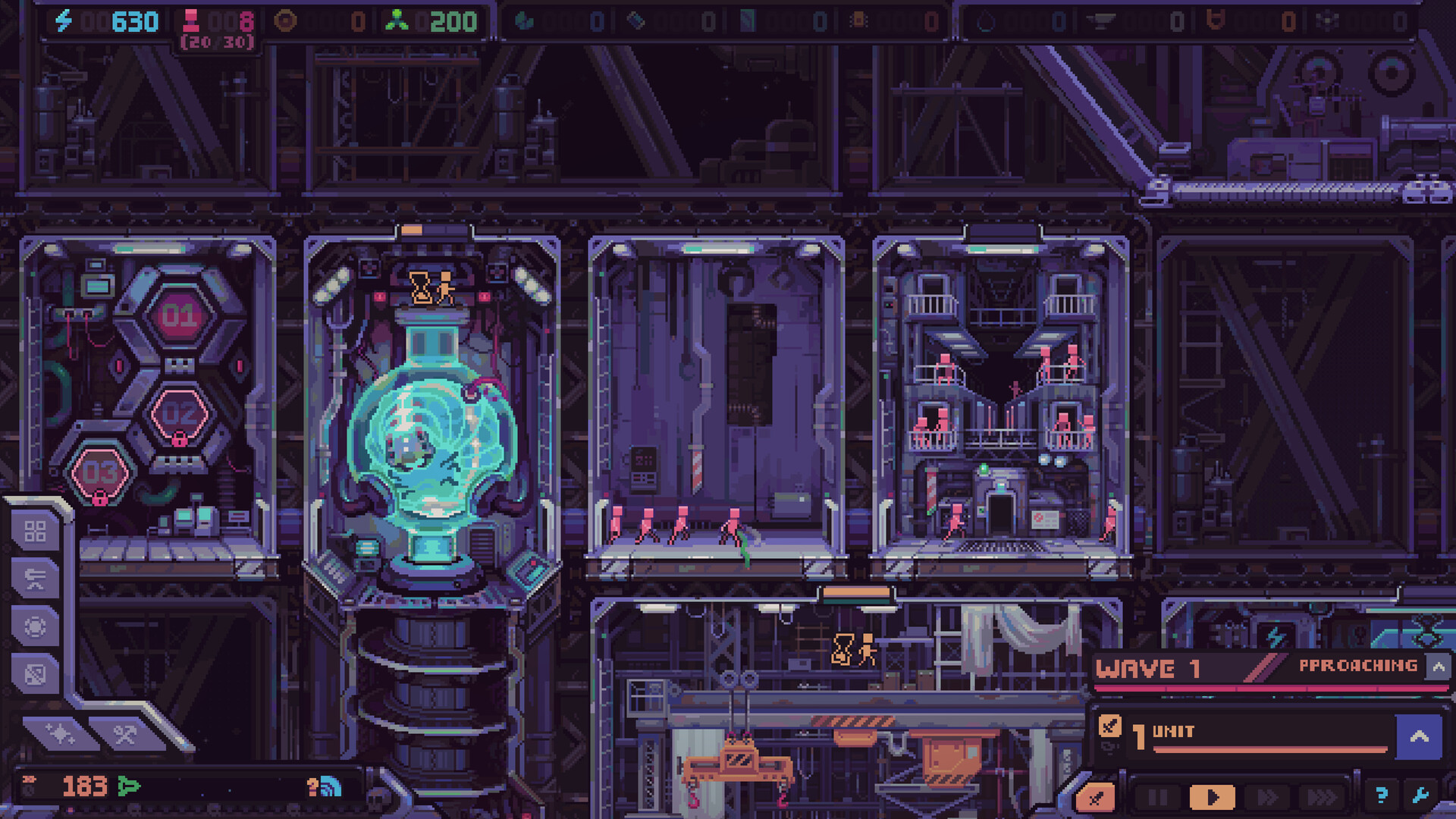
Official Steam screenshot · © 2026 Konfa Games / tinyBuild
Separate the roles of your resources
Energy and Fuel are distinct parts of the ship's management system. Humans also contribute to the workforce, while construction materials support different building decisions. Treating every shortage as interchangeable makes diagnosis harder, because a healthy supply of one resource does not automatically satisfy a requirement for a different one.
Begin with the requirement of the system you want to operate or construct. Identify what is missing, then trace how the ship can provide it. This is more useful than asking whether the overall vessel looks developed, because a large collection of modules can still leave the specific producer or support relationship you need unresolved.
Put workers into useful production
The management devlog makes workforce part of the economy rather than a separate cosmetic count. A producer and the people assigned to it need to be considered together. When output is inadequate, inspect whether the useful jobs are staffed before spending resources on another piece of equipment that may depend on the same limited workforce.
Think about the change you are trying to make in terms of working systems. Adding a module creates an option, while making that option contribute can require people and inputs. This distinction helps explain why expansion does not always produce the expected improvement immediately and why a staffing adjustment can be a better first investigation than further construction.
Follow the input chain behind a shortage
If a consumer cannot keep working, inspect the resources it needs upstream. A production chain depends on those inputs continuing to arrive, not simply on the consumer being present in the hull. Find the producer or acquisition route behind the missing resource before assuming that a new storage module is the required answer.
Work backward from the visible symptom. Identify the missing input, then inspect the system responsible for supplying it and the labor that supports that system. This method is a practical interpretation of the documented resource relationships, rather than a fixed recipe tree that assumes every run must unlock equipment in one mandatory order.
Read stock, rate and capacity separately
Stored resources describe what is available now, while production describes how the current arrangement is operating. Capacity is a different question about the resource situation and should not be confused with generating the missing material. Look at these aspects together before deciding that one favorable number proves the whole chain can support additional demand.
A producer that appeared sufficient can become a constraint after new construction or a change in inputs. Recheck the current arrangement when the ship's needs change. The practical goal is to understand which part of the relationship has stopped supporting the others, rather than carry an earlier positive impression forward as proof that nothing in the chain can be wrong.
Distinguish a kit from the resources to build it
An equipment option does not remove its construction requirements. If a kit is available but the associated module cannot be built, inspect the material requirements and available labor separately from the kit itself. This prevents an acquisition question from being mistaken for a production question, even though both can stop the same planned expansion.
Before buying something to resolve a shortage, check whether the ship can complete the full decision. Consider the kit, construction and the support needed afterward. A purchase that uses scarce resources without producing a functioning improvement can leave the original constraint in place and make the next useful correction harder to fund.
Interpret Uncommon-resource tutorial wording carefully
A developer reply in the June demo discussion identifies Plasteel, Mineral, Isotope and Microchip as Uncommon-resource module categories. That example helps distinguish a request involving resource production from an assumption that the tutorial always means storage. Keep its June context visible rather than treating the post as a complete list of release recipes or module outputs.
When a tutorial resource seems unavailable, read what the instruction is asking you to produce or construct. Then compare it with the producer and equipment options actually present in the game. The useful lesson from the documented discussion is to identify the resource category correctly, not to invent a separate storage requirement or a numerical recipe that the source does not establish.
Expand at a pace the ship can support
The developer links workforce, Energy, Fuel and ship mass as constraints on growth. More production space is therefore only one part of an expansion decision. Consider what the growing vessel will need to keep functioning and moving, rather than judging the next addition solely by the output you hope to gain from its new module.
Use the shortage diagnosis before adding more operating demand. If the present economy is already limited by an unsupported input or understaffed job, another consumer may amplify the pressure. Resolve the specific bottleneck, then reconsider the proposed growth with the corrected resource situation in view instead of repeating the same expansion decision automatically.
Make the next correction specific
For an immediate shortage, identify the missing resource and inspect its producer, inputs and workforce. For unavailable construction, inspect the kit and building requirements. For slow movement, include Fuel, engines and mass in the investigation instead of assuming that Energy production alone answers every question about the vessel's ability to continue the journey.
After the correction, reassess the whole chain before making another commitment. The power guide goes deeper into Energy diagnosis, while the module and kit pages separate equipment roles from acquisition. Keeping those questions distinct gives you a practical way to sustain production without relying on invented conversion ratios, universal staffing numbers or an unverified release-wide resource tree.
Distinguish missing supply from a spending decision
Suppose the ship has an equipment option available while the resource it needs is already under pressure. Start by identifying whether the requirement is a construction payment or an ongoing input. Then inspect how the resource is currently produced and what supports that producer. This keeps the diagnosis grounded in the actual requirement instead of assuming that any available kit is immediately usable or that another consumer will automatically create the supply it needs.
Once the constraint is understood, compare the proposed expansion with a targeted correction. Useful staffing, an upstream supply or a different acquisition route can answer a different problem from additional storage. Choose the response that matches the missing relationship and recheck the result before spending again. This review is deliberately based on roles and dependencies rather than fixed numerical recipes, because a sustainable production decision must fit the systems and resources present on the current ship.
Sources and version notes
- Devlog #1 — Base Building and Ship Management · 2026-05-23
- Tutorial resources unavailable — developer reply and player clarification · 2026-06-15
Source dates identify the announcement or discussion behind the information. Historical demo rules are distinguished from the full-release changes described in the article.
Send a correction →