
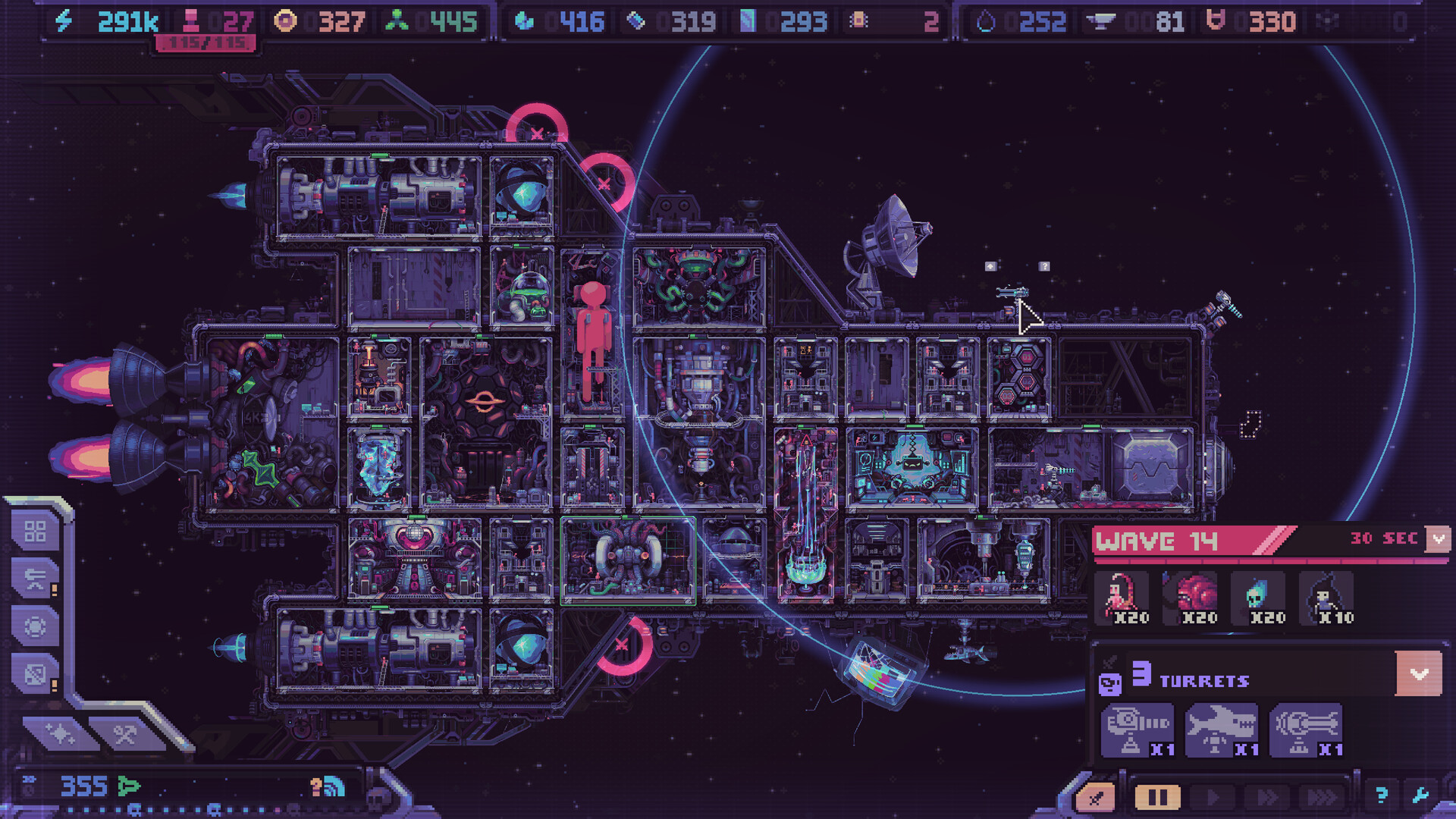
Official Steam screenshot · © 2026 Konfa Games / tinyBuild
Separate hull blocks from the modules inside
A hull block provides geometry and module slots. The equipment placed inside that space is a different part of the ship, with its own construction decision and function. Keeping those two layers separate is important when planning an expansion, because changing equipment is not the same action as reversing the shape of the hull itself.
The October devlog says placed hull blocks cannot be destroyed. Do not interpret information about demolishing modules or moving turrets as permission to remove the underlying block. Review the shape first, then think about the systems it can accommodate, so a temporary equipment choice does not become the reason for an unsuitable permanent hull decision.
Use the construction pause to inspect the shape
Hull Construction pauses flight while you choose where to place the offered block. Use that opportunity to examine the resulting space and route, instead of treating the pause as a reason to place the piece as quickly as possible. A good inspection considers what can fit inside and how aliens would move around the addition.
Start with the modules you already need or are preparing to support. Then compare the new route with the behavior of the defenses you have available. This is a practical planning sequence based on the construction system, rather than a claim that every offered block has one correct position regardless of the ship or equipment.
Understand the documented block cycle
The October 22 devlog describes 15 different construction blocks. They appear in a shuffled order without repeating until that set has been cycled through. This is a dated description of the block system, so it should not be turned into a promise that the same ship shape will be available in the same sequence during every attempt.
Plan around the piece currently offered rather than a fixed sequence of future expansions. The September construction description also states that offered blocks cannot be rotated. Consider the orientation as part of the decision, instead of assuming a familiar rotation control from another building game will make an otherwise unsuitable shape fit your intended arrangement.
Keep the engine and Airlock clear
The placement rules do not allow hull blocks to obstruct the engine or Airlock. These are constraints to check before comparing the more subtle benefits of a layout. An expansion that appears useful for internal space still has to respect the ship's essential access points and the route structure around them.
Inspect the full outline of the offered piece, not just the slot you are most interested in using. The important question is what the whole placement does to the ship. Thinking about access, usable space and approach routes together reduces the chance of evaluating a permanent block solely by one attractive module position it provides.
Build in empty slots without the old restriction
The November release FAQ explicitly removes the demo's neighboring-module requirement. In the full release, any empty module slot can be used for construction. You do not need to complete a module next door merely to make an otherwise empty slot available, even if an older guide describes that earlier restriction.
Separate this general release rule from a particular modifier's positioning condition. A bonus that depends on adjacency is a reason to think carefully about layout, but it is not the same as a universal restriction on where construction may begin. Apply the release placement rule first, then evaluate the individual interaction you actually want to use.
Choose between compact space and longer routes
The construction devlog contrasts compact arrangements with layouts that give enemies farther to travel. Closely grouped modules can help adjacency interactions and reduce human travel distances. A more extended defensive route can create additional firing opportunities, so the alternatives have different benefits rather than one being automatically superior in every run.
Evaluate which benefit serves the current ship. If the available weapons need a useful approach, inspect whether the proposed geometry provides it; if the plan depends on a positional interaction, inspect the arrangement of the modules involved. Avoid assuming that more hull or more separation always improves both the economy and defense at the same time.
Make positions suit the weapon behavior
The devlog describes exposed positions as useful for long-range coverage and enclosed areas as useful for shorter-range weapons. This makes the outline and gaps around blocks part of the combat decision. Consider what enemies will pass and where the available weapon can contribute before treating the new internal space as the whole value of an expansion.
The September construction rules also describe placing a block a short distance from the hull to create a supported corridor. That historical description illustrates why geometry can influence routes beyond a simple solid rectangle. Use the documented placement behavior and the current offered piece, rather than assuming every gap or imagined corridor is legal without checking it.
Review the permanent choice before committing
Before placement, ask what module space the block creates, what route it changes and whether it respects the engine and Airlock. Then inspect whether the chosen orientation works without rotation. These checks focus on documented construction constraints and the practical trade-off between a functioning interior and a useful defensive exterior.
Once the shape is chosen, use the build and turret guides to plan equipment within that geometry. Use the boss guide when reviewing the longest important approach toward the Airlock. Keeping these decisions connected helps hull growth serve a coherent ship, while preserving the distinction between permanent construction and the equipment decisions made inside it.
Inspect the offered block from two viewpoints
First inspect the piece as interior space, considering the modules you want to place, the available slots and any positioning relationship the plan needs to use. Then inspect exactly the same piece as an exterior route change. This second pass asks how enemies approach, where a useful firing position appears and whether the proposed orientation serves the available defenses. Neither viewpoint replaces the placement restrictions, so the engine, Airlock and permanent nature of the choice still need checking before confirmation.
Compare the result with the ship you already have. If the piece provides room but no clear use for it, review whether that expansion actually serves the current plan. If it creates an appealing route but leaves the intended equipment unsupported, inspect the production commitment as well. This two-pass review makes construction a deliberate connection between management and defense instead of a search for the largest possible hull outline without regard to what the added geometry will do.
Sources and version notes
- Devlog #4 — Hull Construction Deep Dive · 2026-10-22
- Everything You Need to Know Before Hull Rupture Launches · 2026-11-02
- Hull Rupture Launches November 4 + Major Demo Update · 2026-09-14
Source dates identify the announcement or discussion behind the information. Historical demo rules are distinguished from the full-release changes described in the article.
Send a correction →