
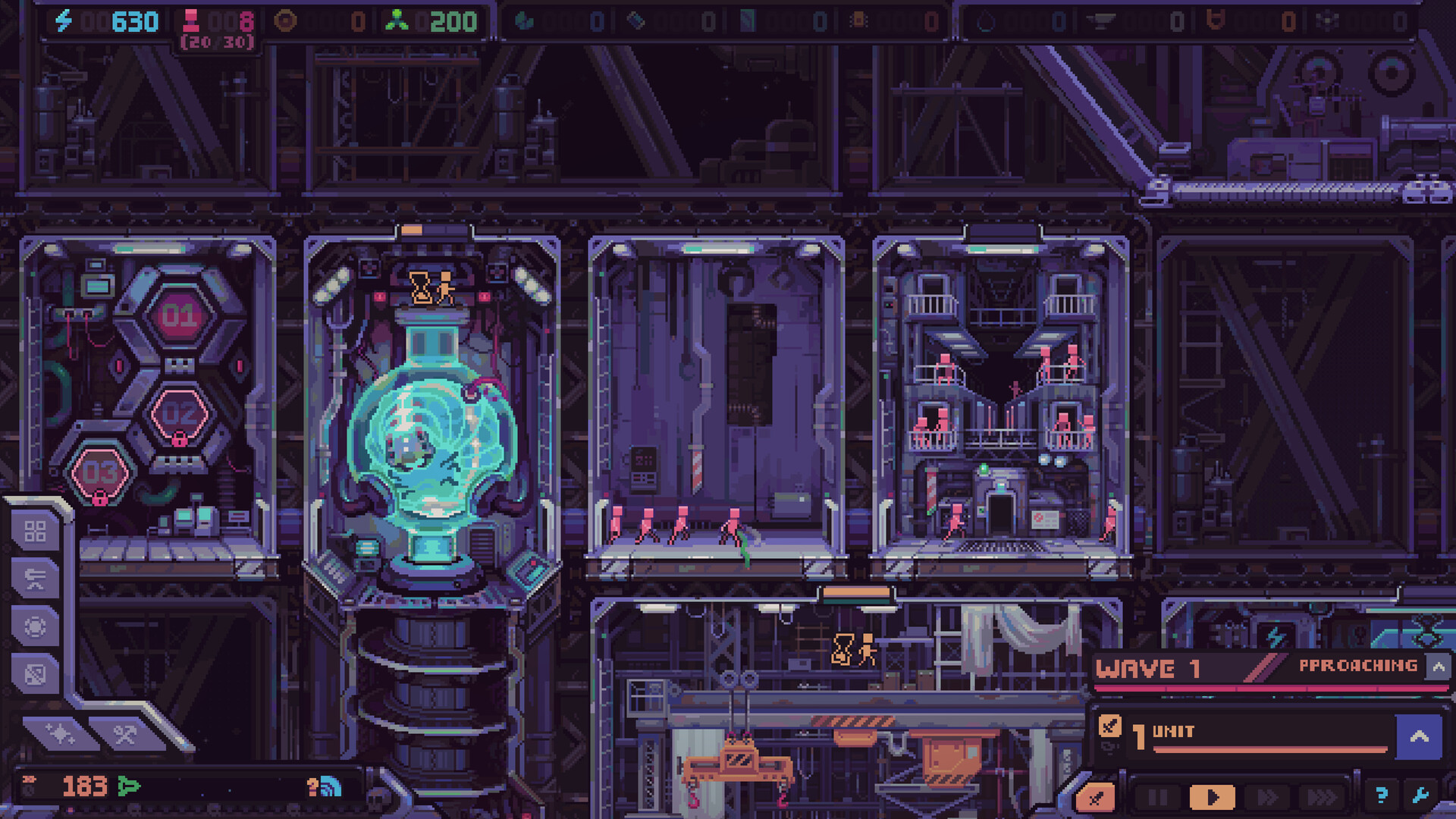
Official Steam screenshot · © 2026 Konfa Games / tinyBuild
Start with the system producing Energy
Available humans and useful assignments matter to early production. Before expanding the ship to address a shortage, inspect the jobs associated with the Energy producer and whether they are being performed. This keeps the diagnosis focused on a functioning supply rather than assuming that owning equipment is equivalent to getting useful work from it.
The management devlog warns against growing beyond available Energy. That warning makes existing production the sensible starting point for a power investigation. Ask what the present system can support, then compare the next proposed addition with that situation instead of planning as though the producer's presence alone gives the ship unlimited room to grow.
Distinguish construction spending from operating demand
Building something and supporting the resulting production are related but different decisions. A one-time resource bill can be affordable even when the ship is not ready for the demand associated with its growing systems. Inspect both sides before committing to an addition that appears attractive only because the current stock is sufficient to begin construction.
When a shortage appears after expansion, review what changed. Look at the new consumers and the useful workers available to support production. This does not require inventing a universal amount of spare Energy; it requires identifying the particular demand added by the choice and whether the existing supply can continue supporting the ship afterward.
Use Info Mode without treating it as a forecast
The September update describes the resource display as current output per minute. It reports what the present arrangement is doing, rather than predicting that the same result will continue after resource inputs or capacity change. A favorable value is therefore useful information, but it is not a guarantee against a later production interruption.
Read the number together with the producer's requirements. If upstream resources become unavailable, the earlier rate cannot prove that the chain remains sustainable. Revisit the display after a meaningful change to the economy, and inspect the conditions behind the number instead of using an old positive result to rule out a current input or staffing problem.
Trace unexpected drops to their inputs
When output falls or a module stops, check the inputs and capacity that support the work. The useful question is what the system needs now, not simply what it produced earlier in the run. A rate change can be a reason to investigate the chain behind the producer rather than immediately replace the entire power arrangement.
Start from the system that is no longer contributing and follow its requirements upstream. Identify whether useful labor, resource availability or another constraint is responsible for the interruption. This targeted method avoids treating every Energy problem as proof that the ship needs more unsupported construction, which can add demands before the original issue is understood.
Check a blocked build as a separate problem
A module that cannot be constructed is not necessarily evidence of insufficient ongoing Energy production. The kit, construction requirements and free workforce also need checking. Separate those questions so the ship does not spend resources on an unrelated correction simply because the planned equipment is currently unavailable.
Inspect what the game is asking for at the construction step. Compare that requirement with the resource and labor situation before deciding which system needs attention. The practical benefit is clearer diagnosis: an acquisition issue, a building-cost issue and an operating-supply issue can all interrupt a plan, but they do not call for the same response.
Keep Fuel and movement in the same review
Energy production does not answer every question about ship movement. The management and exploration material also links engines, Fuel, staffing and ship mass to travel. If the ship is moving more slowly than intended, include those constraints instead of treating Energy as interchangeable with every other form of support the vessel needs.
This is especially relevant when expansion changes the scale of the ship. Review what the new growth asks of movement as well as production. A power decision that appears successful in isolation may still leave a travel constraint unresolved, so examine the broader operating arrangement before assuming one repaired number means the whole vessel is ready for another ambitious addition.
Evaluate the next consumer before building it
Ask what useful work the proposed module would enable and what support it needs. Then compare that requirement with the current production and staffing arrangement. If the existing ship is already exposing a shortage, the next investment should address the responsible system rather than add demand because the available kit looks valuable in a different context.
Do the same review after a change restores output. A correction gives you a new current state to evaluate, not automatic permission to continue the earlier expansion plan unchanged. Use the resource page to inspect the connected inputs and the exploration page to consider travel costs when the next investment affects several parts of the ship together.
Use a short Energy troubleshooting routine
Check useful generator staffing, inspect new demand and follow the required inputs before adding more production. Compare the current rate with the resources supporting it, then distinguish the immediate shortage from a separate construction or travel problem. These checks come from the documented management relationships and do not depend on importing wiring or battery mechanics from unrelated games.
Keep the correction specific to the symptom you found. If staffing is the issue, investigate assignments; if an input is the issue, investigate its supply; if the problem followed growth, review the new demand. Repeating that routine makes power management part of the normal expansion decision rather than an emergency guess after every change to the vessel.
Review the change that created the symptom
If Energy becomes a problem after a new investment, use that timing to focus the investigation without assuming it proves a specific cause. Inspect the added demand, the assignments supporting the producer and the inputs that were available before the change. Compare those conditions with the present ship rather than rely on a remembered positive rate. The aim is to identify the changed relationship, not to assign a universal spare-capacity number that the material does not provide.
After a correction, consider the next planned consumer as a fresh decision. The restored output shows that the current arrangement is working under its current conditions. It does not remove the need to inspect the demands of another addition. Applying that review consistently makes Energy management part of each expansion choice, while the separate Fuel and movement checks prevent a repaired power situation from being mistaken for proof that every other operating constraint has also been solved.
Sources and version notes
- Devlog #1 — Base Building and Ship Management · 2026-05-23
- Hull Rupture Launches November 4 + Major Demo Update · 2026-09-14
- Devlog #3 — Galaxy Exploration and Choices · 2026-08-14
Source dates identify the announcement or discussion behind the information. Historical demo rules are distinguished from the full-release changes described in the article.
Send a correction →