
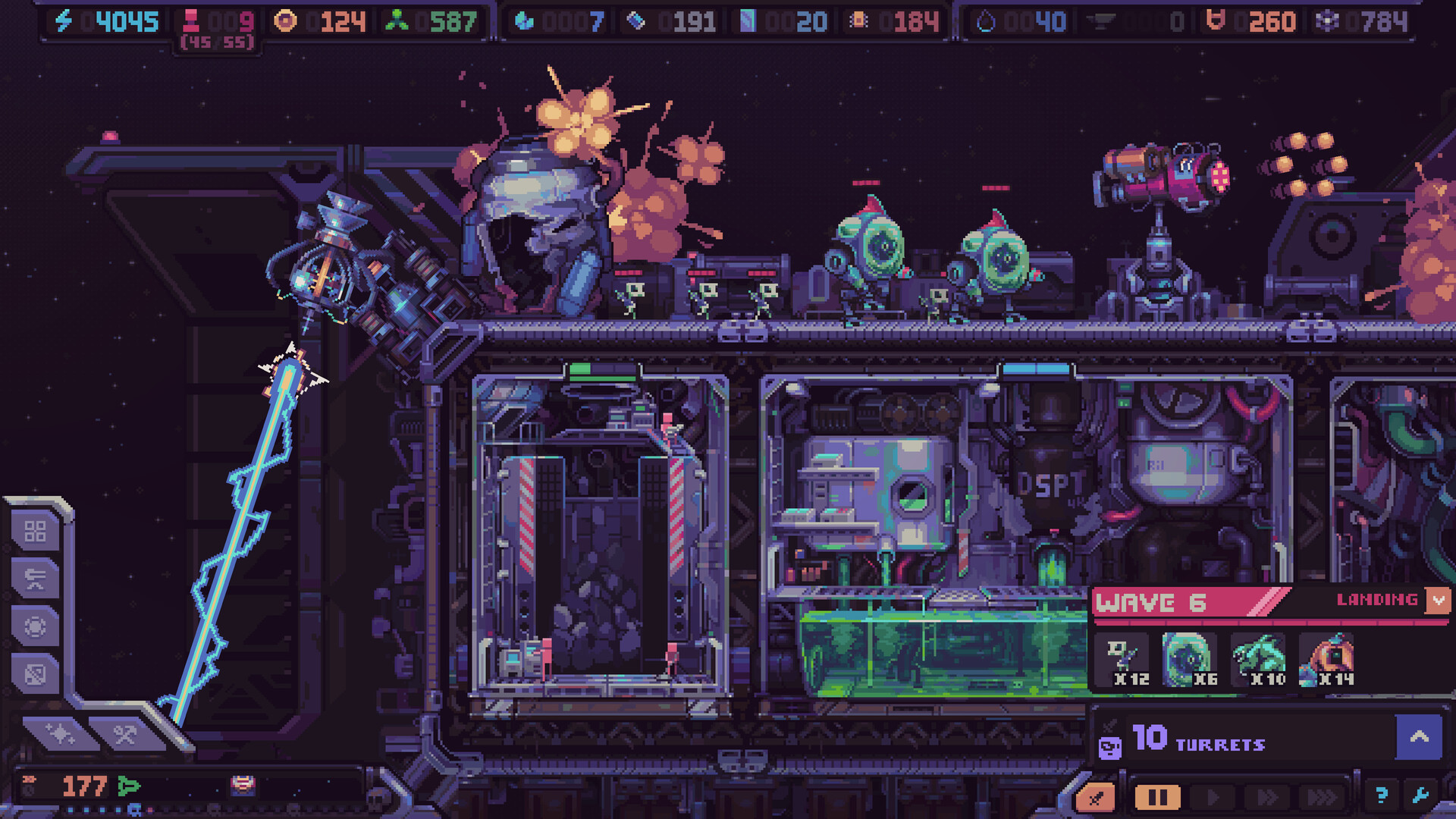
Official Steam screenshot · © 2026 Konfa Games / tinyBuild
Start with the actual Classic objective
Classic requires surviving 20 alien waves. The full-release FAQ separates Endless into its own mode, so completing this objective is different from planning for an automatic indefinite continuation. Your resource decisions should therefore support finishing the Classic challenge rather than assume every investment has unlimited time to become useful.
Despot's survival remains the condition that matters throughout the run. A strong production arrangement does not replace protection, because losing Despot ends the attempt before a future economic benefit can help. Keep that relationship in mind whenever a choice promises more growth but does little to address the attacks the current ship must withstand.
Stabilize the early economy without ignoring combat
The early part of a run is a useful time to establish staffing and productive systems. Available humans, Energy and construction requirements determine which additions can actually help. Get useful work from the systems you have, then add the production that supports a real need instead of expanding simply because a new kit becomes available.
Cover incoming approaches while doing that economic work. The point of developing production is to support the run, not to postpone every defensive decision until the ship is already struggling. Look at the current route and the equipment available, then keep the opening investment connected to surviving the next attack as well as financing later choices.
Use the middle of the run to remove bottlenecks
Once the basic arrangement exists, inspect what is preventing it from working well. A shortage may concern staffing, an upstream input or the demand created by growth. Correct the specific constraint before assuming that another advanced consumer will improve the whole ship, because unsupported additions can leave the same underlying problem in place.
This is also the stage to consider whether the hull route still suits the weapons in use. The combat devlog links effective defense to firing behavior and layout. A new addition should improve that relationship or solve an economic need, rather than increase the vessel's size without a clear contribution to the remaining challenge.
Choose a defensive approach you can fund
Different defensive setups can place different demands on the economy. The developer describes both support for expensive turrets and approaches that strengthen cheaper equipment with bonuses. The useful choice is the one the current ship can sustain, with the available kits, modifiers and routes considered together rather than evaluated as unrelated advantages.
Do not assume that a more expensive option is automatically the correct next purchase. Consider what it needs and what it will actually cover after construction. If its support requires several additional commitments, compare those demands with a coherent improvement to the defense you already have rather than treating the purchase price as the only cost that matters.
Make the late economy contribute before the finish
As the Classic objective approaches, consider when a new production project can become useful. An investment whose benefits arrive only after the run's remaining needs have become critical does not solve those needs now. This is an editorial spending principle derived from the fixed objective, not a hidden in-game cutoff at a particular wave number.
Direct available resources toward improvements that can help protect Despot through the remaining attacks. That can mean strengthening useful coverage rather than extending an economic plan indefinitely. Reassess each expansion by asking what it contributes before Classic ends, while maintaining the operating support the existing ship still needs to complete the journey.
Prepare the final approach deliberately
The preparation framework includes reviewing the boss approach and the route enemies must travel. Give your available weapons useful opportunities to contribute before relying on the final defensive point. Think about geometry, complementary effects and coverage as parts of the same plan, rather than expecting the Airlock to compensate for every weakness elsewhere.
Preparation should occur while choices can still be made deliberately. Avoid basing the plan on an assumed sequence of emergency purchases or a specific item that has not appeared. Use the dedicated boss guide to examine the documented approach principles, keeping this page focused on how the economy and defense develop toward the Classic finish.
Do not copy a demo clear without context
A community account of surviving 20 waves in the demo describes a historical result. Later changes to defenses and full-release progression mean that result does not automatically establish a current universal build. Compare the version and the rules behind an older success before turning it into a shopping order for the release.
The clearest release distinction is that Endless no longer follows Classic automatically. That changes the context for advice about what a 20-wave completion means. Use current official rules to define the target, then apply the older material only where the underlying mechanic is supported rather than assuming the entire run remains identical.
Evaluate the run by what actually failed
If an attempt ends before the objective, identify whether the decisive problem was unsupported production, an inadequate route or insufficient defensive coverage. Those are different planning problems and should lead to different next-run priorities. Avoid assigning the whole failure to a missing ideal item when the ship may have exposed a more immediate economic or geometric weakness.
For the next attempt, keep the stable parts of the plan and address the constraint you identified. Use the resource guide for production problems and the build or turret pages for defensive structure. This phased framework provides a practical way to work toward 20 waves without inventing fixed turret counts, exact boss thresholds or a guaranteed winning sequence.
Make each investment answer the remaining challenge
For a practical spending review, consider a production project and a defensive improvement available at the same point in a Classic run. Ask what each choice needs before it can contribute and which current problem it solves. The production option may support later decisions, while the defensive option may address an approach already under pressure. Compare those purposes with the remaining objective rather than assume that economic growth or immediate firepower is always the correct choice independently of the ship's condition.
This is the reason the plan uses phases without assigning fixed wave cutoffs. The available kits, production bottlenecks and hull arrangements can differ between attempts. Use the early, middle and final-stage questions as ways to inspect the current run, not a schedule that overrides what the game is showing. The target stays concrete: maintain the systems needed to move and put enough useful protection in place to keep Despot alive through Classic's remaining attacks.
Sources and version notes
- Everything You Need to Know Before Hull Rupture Launches · 2026-11-02
- Devlog #2 — Not Your Typical Tower Defense · 2026-06-18
- Devlog #1 — Base Building and Ship Management · 2026-05-23
Source dates identify the announcement or discussion behind the information. Historical demo rules are distinguished from the full-release changes described in the article.
Send a correction →